


Literacy
Literacy is at the core of what we do, and what we have always done at Chelsea School. In 1976, our school was founded to serve the needs of students with dyslexia.
At Chelsea School, our reading teachers and reading specialists are trained in the Orton-Gillingham model for literacy remediation. Orton-Gillingham is a highly structured approach that breaks reading and spelling down into smaller skills involving letters and sounds and then builds on these skills over time.
The Orton-Gillingham model is a highly-structured approach to literacy remediation that teaches phonemic awareness by breaking reading and spelling down into small skills based on letters and sounds that build over time. The program allows teachers to individualize instruction for their students in a way that matches their learning style.
“It was the first approach to use explicit, direct, sequential, systematic, multi-sensory instruction to teach reading, which is effective for all students and essential for teaching students with dyslexia.” (www.orton-gillinhgam.com)
Students proceed through the sequence of acquired skills by seeing, saying, sounding, and writing letters to master the decoding and encoding of worlds. This multisensory approach incorporates visual, aural, tactile, and kinesthetic modalities.
Literacy at Chelsea
Literacy remediation is at the core of Chelsea School’s program model and it is the first consideration when creating a student’s schedule. Chelsea School employs reading specialists and teachers who are trained in the Orton-Gillingham approach to literacy remediation, a “direct, explicit, multisensory, structured sequential, diagnostic, and prescriptive” program for students with dyslexia and other language-based learning disabilities. Besides Orton-Gillingham specialization, our reading teachers also have training in a diverse range of methodologies, including Slingerland, Wilson, Linguistic Remedies, and Visualizing and Verbalizing.
Our three-tiered reading program is based on the acquisition of the basic skills of sound-symbol recognition and decoding, fluency, and comprehension.

Students can move in between tiers based on their skill acquisition, and sometimes groups are formed that combine the skills of two tier areas. Students are scheduled in these tutorials based on their current skill deficits, learning style, diagnostic data, and other individualized factors. Students attend their Reading Tutorial classes for 45 minutes each day Monday thru Thursday and for 30 minutes on Fridays.
Reading Tutorials do not follow a state curriculum, but are rather based on the Orton-Gillingham sequence of skill acquisition and the goals and objectives of each student’s IEP. Reading teachers collaborate with their fellow teachers, providing literacy data, leading professional development, and consulting on best practice for instructional methods.
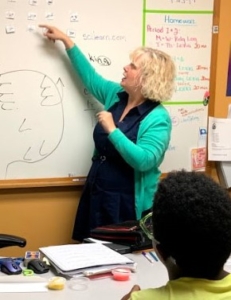
Orton-Gillingham’s Five Pillars of Literacy
Phonological Awareness: The awareness that words are composed of sounds and those sounds have distinct articulatory features
Phonics: The ability to recognize letter-sound relationships in words
Fluency: The ability to read with speed, accuracy, and proper expression
Vocabulary: Size and word-meaning strategies predict comprehension
Comprehension: Understanding the meaning of text and integrating it with previous knowledge
What is Dyslexia?
What is Dyslexia?
Dyslexia is a language-based learning disability. Dyslexia refers to a cluster of symptoms, which result in people having difficulties with specific language skills, particularly reading. Students with dyslexia usually experience difficulties with other language skills such as spelling, writing, and pronouncing words. Dyslexia affects individuals throughout their lives; however, its impact can change at different stages in a person’s life. It is referred to as a learning disability because dyslexia can make it very difficult for a student to succeed academically in the typical instructional environment, and in its more severe forms, will qualify a student for special education, special accommodations, or extra support services.
Source: International Dyslexia Association. https://dyslexiaida.org/dyslexia-basics/
What Causes Dyslexia?
The exact causes of dyslexia are still not completely clear, but anatomical and brain imagery studies show differences in the way the brain of a person with dyslexia develops and functions. Moreover, most people with dyslexia have been found to have problems with identifying the separate speech sounds within a word and/or learning how letters represent those sounds, a key factor in their reading difficulties. Dyslexia is not due to either lack of intelligence or desire to learn; with appropriate teaching methods, students with dyslexia can learn successfully.
Source: International Dyslexia Association. https://dyslexiaida.org/dyslexia-basics/
How Widespread is Dyslexia?
About 13–14% of the school population nationwide has a handicapping condition that qualifies them for special education. Current studies indicate that one half of all the students who qualify for special education are classified as having a learning disability (LD) (6–7%). About 85% of those students have a primary learning disability in reading and language processing. Nevertheless, many more people— perhaps as many as 15–20% of the population as a whole—have some of the symptoms of dyslexia, including slow or inaccurate reading, poor spelling, poor writing, or mixing up similar words. Not all of these will qualify for special education, but they are likely to struggle with many aspects of academic learning and are likely to benefit from systematic, explicit, instruction in reading, writing, and language.
Dyslexia occurs in people of all backgrounds and intellectual levels. People with dyslexia can be very bright. They are often capable or even gifted in areas such as art, computer science, design, drama, electronics, math, mechanics, music, physics, sales, and sports.
In addition, dyslexia runs in families; parents with dyslexia are very likely to have children with dyslexia. For some people, their dyslexia is identified early in their lives, but for others, their dyslexia goes unidentified until they get older.
Source: International Dyslexia Association. https://dyslexiaida.org/dyslexia-basics/
What are the Effects of Dyslexia?
The impact that dyslexia has is different for each person and depends on the severity of the condition and the effectiveness of instruction or remediation. The core difficulty is with word recognition and reading fluency, spelling, and writing. Some individuals with dyslexia manage to learn early reading and spelling tasks, especially with excellent instruction, but later experience their most debilitating problems when more complex language skills are required, such as grammar, understanding textbook material, and writing essays.
People with dyslexia can also have problems with spoken language, even after they have been exposed to good language models in their homes and good language instruction in school. They may find it difficult to express themselves clearly, or to fully comprehend what others mean when they speak. Such language problems are often difficult to recognize, but they can lead to major problems in school, in the workplace, and in relating to other people. The effects of dyslexia reach well beyond the classroom.
Dyslexia can also affect a person’s self-image. Students with dyslexia often end up feeling “dumb” and less capable than they actually are. After experiencing a great deal of stress due to academic problems, a student may become discouraged about continuing in school.
Source: International Dyslexia Association. https://dyslexiaida.org/dyslexia-basics/
How is Dyslexia Diagnosed?
Before referring a student for a comprehensive evaluation, a school or district may choose to track a student’s progress with a brief screening test and identify whether the student is progressing at a “benchmark” level that predicts success in reading. If a student is below that benchmark (which is equivalent to about the 40th percentile nationally), the school may immediately deliver intensive and individualized supplemental reading instruction before determining whether the student needs a comprehensive evaluation that would lead to a designation of special education eligibility. Some students simply need more structured and systematic instruction to get back on track; they do not have learning disabilities. For those students and even for those with dyslexia, putting the emphasis on preventive or early intervention makes sense. There is no benefit to the child if special instruction is delayed for months while waiting for an involved testing process to occur. These practices of teaching first, and then determining who needs diagnostic testing based on response to instruction, are encouraged by federal policies known as Response to Intervention (RTI). Parents should know, however, that at any point they have the right to request a comprehensive evaluation under the IDEA law, whether or not the student is receiving instruction under an RTI model.
A comprehensive evaluation typically includes intellectual and academic achievement testing, as well as an assessment of the critical underlying language skills that are closely linked to dyslexia. These include receptive (listening) and expressive language skills, phonological skills including phonemic awareness, and also a student’s ability to rapidly name letters and numbers. A student’s ability to read lists of words in isolation, as well as words in context, should also be assessed. If a profile emerges that is characteristic of readers with dyslexia, an individualized intervention plan should be developed, which should include appropriate accommodations, such as extended time. The testing can be conducted by trained school or outside specialists.
Source: International Dyslexia Association. https://dyslexiaida.org/dyslexia-basics/
What are the Signs of Dyslexia?
The problems displayed by individuals with dyslexia involve difficulties in acquiring and using written language. It is a myth that individuals with dyslexia “read backwards,” although spelling can look quite jumbled at times because students have trouble remembering letter symbols for sounds and forming memories for words. Other problems experienced by people with dyslexia include the following:
- Learning to speak
- Learning letters and their sounds
- Organizing written and spoken language
- Memorizing number facts
- Reading quickly enough to comprehend
- Persisting with and comprehending longer reading assignments
- Spelling
- Learning a foreign language
- Correctly doing math operations
Not all students who have difficulties with these skills have dyslexia. Formal testing of reading, language, and writing skills is the only way to confirm a diagnosis of suspected dyslexia.
Source: International Dyslexia Association. https://dyslexiaida.org/dyslexia-basics/
How is Dyslexia Treated?
Dyslexia is a lifelong condition. With proper help, many people with dyslexia can learn to read and write well. Early identification and treatment is the key to helping individuals with dyslexia achieve in school and in life. Most people with dyslexia need help from a teacher, tutor, or therapist specially trained in using a multisensory, structured language approach. It is important for these individuals to be taught by a systematic and explicit method that involves several senses (hearing, seeing, touching) at the same time. Many individuals with dyslexia need one-on-one help so that they can move forward at their own pace. In addition, students with dyslexia often need a great deal of structured practice and immediate, corrective feedback to develop automatic word recognition skills. For students with dyslexia, it is helpful if their outside academic therapists work closely with classroom teachers.
Schools can implement academic accommodations and modifications to help students with dyslexia succeed. For example, a student with dyslexia can be given extra time to complete tasks, help with taking notes, and work assignments that are modified appropriately. Teachers can give recorded tests or allow students with dyslexia to use alternative means of assessment.
Students can benefit from listening to audiobooks and using text reading and word processing computer programs. Students may also need help with emotional issues that sometimes arise as a consequence of difficulties in school. Mental health specialists can help students cope with their struggles.
Source: International Dyslexia Association. https://dyslexiaida.org/dyslexia-basics/
What are the Rights of a Person with Dyslexia?
The Individuals with Disabilities Education Act 2004 (IDEA), Section 504 of the Rehabilitation Act of 1973, and the Americans with Disabilities Act (ADA) define the rights of students with dyslexia and other specific learning disabilities. These individuals are legally entitled to special services to help them overcome and accommodate their learning problems. Such services include education programs designed to meet the needs of these students. The Acts also protect people with dyslexia against unfair and illegal discrimination.
Source: International Dyslexia Association. https://dyslexiaida.org/dyslexia-basics/
